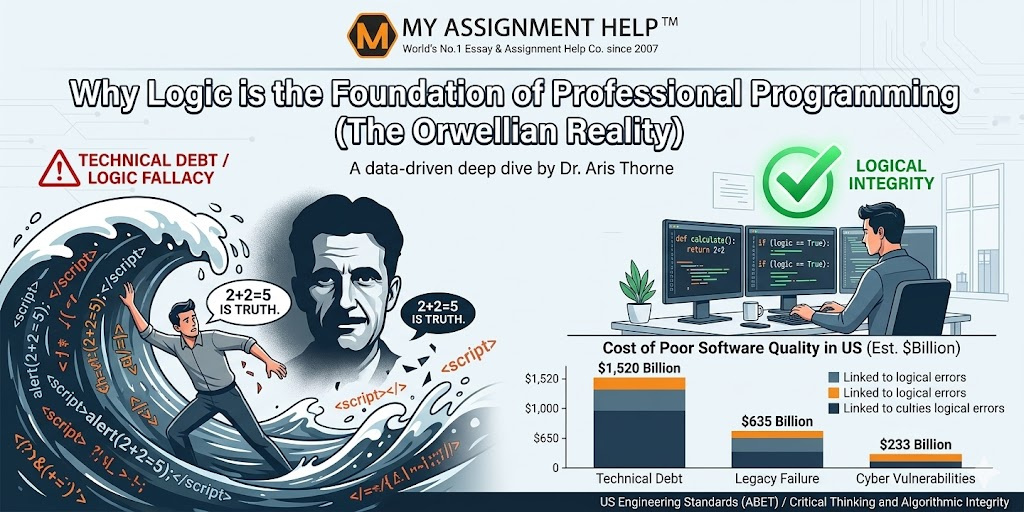
In George Orwell’s dystopian masterpiece 1984, the phrase “2 plus 2 equals 5” serves as the ultimate litmus test for the erosion of objective truth. It represents a world where reality is malleable and logic is a casualty of power. While this may seem like a relic of mid-century political fiction, it remains a hauntingly relevant metaphor for the modern developer. In the digital architecture of the 2026 US tech landscape, logic is not just a philosophical preference; it is the structural integrity upon which every line of code rests.
The Philosophical Trap: When Logic Breaks
To understand why software fails, we must first understand how logic is manipulated. In an academic or literary context, the concept of 2 plus 2 equals 5 illustrates the subversion of foundational axioms. When a system—be it a government or a compiler—demands that you accept a mathematical impossibility, the entire framework collapses. In programming, this “logical gaslighting” occurs when developers ignore edge cases or bypass fundamental boolean truths to force a specific outcome.
The Syntax of Truth
For the modern American computer science student, the transition from high-level logic to functional execution is often where the most significant errors occur. US-based engineering programs, such as those at MIT or Stanford, emphasize “Discrete Mathematics” because it provides the symbolic logic necessary for algorithm design. Without this foundation, writing programming code becomes a game of guesswork rather than an exercise in engineering. When the underlying logic is flawed, no amount of sophisticated syntax can save the program from a runtime disaster.
Data-Driven Reality: The Cost of Illogic
According to recent analysis by the Consortium for Information & Software Quality (CISQ), the economic fallout of logical failures in the United States is staggering. These errors are often the result of “Technical Debt,” where shortcuts in logic lead to long-term systemic vulnerabilities.
| Error Category | Impact on US Economy (Est.) | Primary Cause |
| Legacy System Failure | $635 Billion | Outdated logical frameworks |
| Software Technical Debt | $1.52 Trillion | Rushed logic/Poor documentation |
| Cybersecurity Vulnerabilities | $233 Billion | Logic flaws in authentication |
Why US Academic Standards Demand “Logical Proof”
In the United States, the Accreditation Board for Engineering and Technology (ABET) sets rigorous standards for computer science curricula. They require students to demonstrate an ability to “apply principles of computing and other relevant requirements to identify solutions.” This isn’t just about learning Python or Java; it’s about proving that your solution is logically sound.
When a student submits a project where the output doesn’t align with the input logic, they aren’t just getting a math problem wrong—they are failing the primary requirement of professional software development: Predictability.
The “Orwellian” Debugging Process
Debugging is, in essence, an act of restoration. It is the process of finding where the “2+2=5” error entered the system and correcting it back to “4.” Professional programmers in the US market spend nearly 50% of their time debugging.
- Step 1: Isolation. Finding the specific module where logic deviates.
- Step 2: Verification. Testing the boolean truth of every statement.
- Step 3: Refactoring. Rebuilding the code to ensure the logic is immutable.
Key Takeaways
- Logic is Non-Negotiable: Just as “2+2=4” is a physical truth, code logic must be absolute to ensure security and functionality.
- Interdisciplinary Skills: Success in the US tech market requires a blend of technical syntax and philosophical critical thinking.
- Economic Impact: Logic errors are multi-billion dollar economic drains in the US.
- Academic Rigor: Understanding the theory behind algorithms is as important as the code itself.
Frequently Asked Questions (FAQs)
1. Why is logic more important than learning a specific language like Python?
Programming languages evolve, but the underlying logic (Boolean algebra, set theory) remains constant. If you understand the logic, you can adapt to any tech stack in the US market.
2. How does the “2+2=5” concept apply to Artificial Intelligence?
AI “hallucinations” are essentially modern versions of 2+2=5. When an LLM provides a confident but false answer, it is failing the test of logical consistency.
3. What are the most common logic errors in student programming assignments?
Common errors include off-by-one errors in loops, null pointer exceptions, and incorrect conditional branching (using ‘OR’ when ‘AND’ is required).
Author Bio
Dr. Aris Thorne is a Senior Content Strategist and Academic Consultant at MyAssignmentHelp. With over 15 years of experience in Software Engineering and a PhD in Computer Science from a leading US university, Dr. Thorne specializes in bridging the gap between theoretical logic and professional application. He has mentored thousands of students across North America, helping them navigate the complexities of algorithmic integrity.